

Did you know that a structured preventive maintenance schedule can reduce emergency repairs by up to 60% and extend the life of your home systems by a quarter? For many homeowners, the reality of house maintenance record keeping is a stressful scramble through drawers for faded boiler receipts or misplaced electrical certificates. It is exhausting to manage various tradespeople whilst worrying if you are meeting the latest UK safety regulations or protecting your property's long-term market value.
We believe that your home deserves a professional level of oversight that provides total peace of mind. This guide will teach you how to organise a professional-grade home maintenance log that secures your investment and simplifies every repair. You will discover how to build a digital Home Passport that acts as a verified identity for your property. This system ensures you stay compliant with the latest 2026 council enforcement powers and maximises your resale potential through a transparent, high-tech history.
Key Takeaways
- Understand why systematic house maintenance record keeping is becoming the industry standard for protecting your property's resale value in the Newcastle market.
- Learn how to categorise your records into three essential tiers, ranging from mandatory safety certificates to high-value aesthetic upgrades.
- Evaluate the strengths and risks of traditional physical folders compared to modern, secure digital Home Passports.
- Discover a step-by-step audit process to identify missing warranties and set automated digital alerts for recurring safety checks.
- Explore how a tech-forward digital logbook integrates vetted trade bookings to create a permanent, verified history for your home.
The Strategic Importance of House Maintenance Record Keeping in 2026
House maintenance record keeping is no longer just a hobby for the meticulously organised. It has become the systematic documentation of all property care, repairs, and upgrades, serving as a definitive digital identity for your home. In the 2026 market, we have seen a fundamental shift from reactive fixing to proactive asset management. This transition means a "CARFAX-style" history is becoming the benchmark for Newcastle property sales. When every boiler service and roof repair is logged, it creates a level of transparency that significantly reduces friction amongst buyers, sellers, and surveyors. It transforms a house from a collection of bricks into a verified, high-value financial asset.
This level of property maintenance transparency removes the guesswork that often stalls transactions. By maintaining a professional log, you aren't just filing papers; you are building a narrative of reliability. It shows that you have acted as a tech-forward guardian of the structure, ensuring that every component from the foundations to the smart thermostats is functioning at its peak. This rigorous approach to documentation is the most effective way to protect the structural integrity and market appeal of your home over the long term.
Protecting Your Property Value in the Newcastle Market
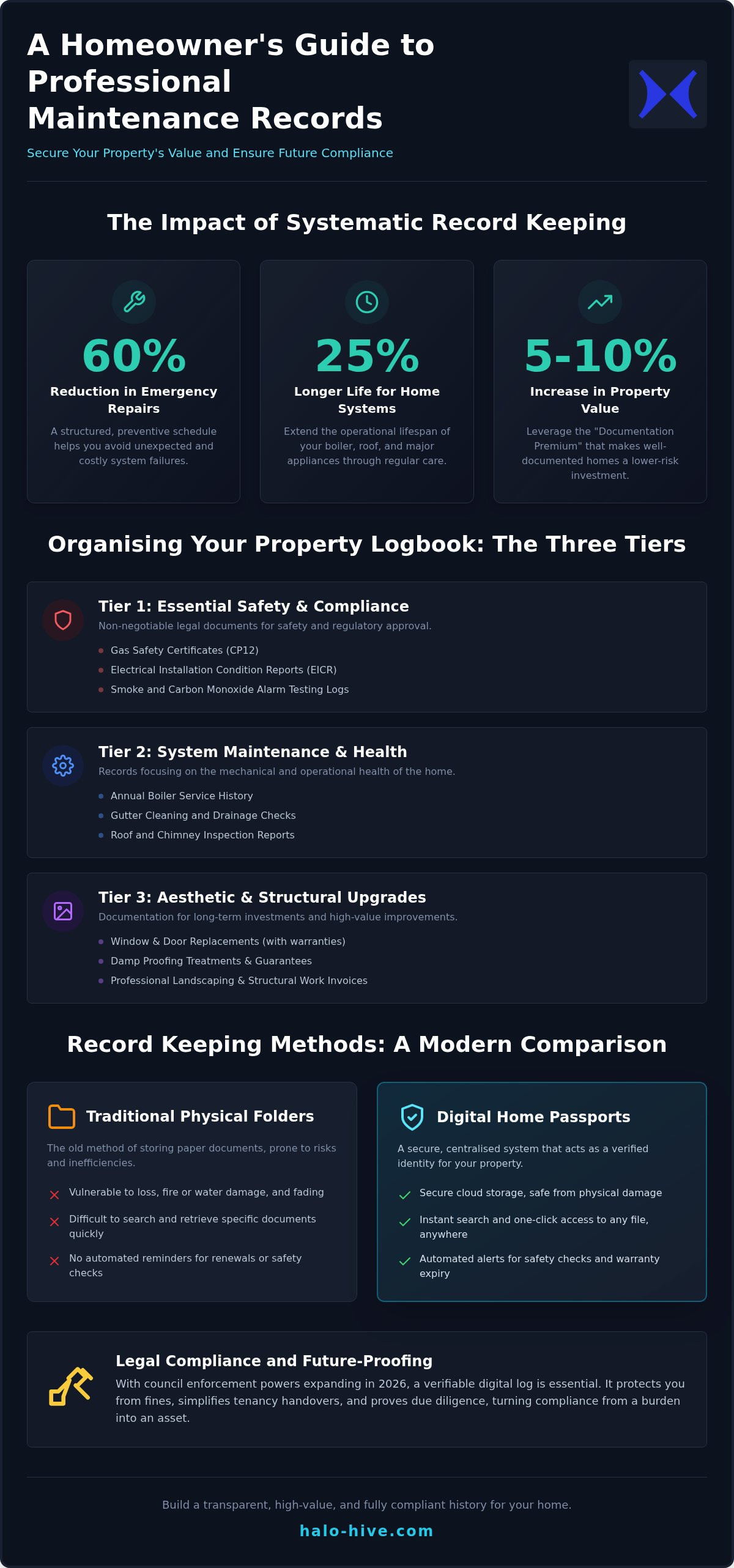
A verified maintenance history acts as a shield against market volatility. When a surveyor enters your home, having a professional logbook allows you to justify your asking price with hard data rather than anecdotes. This documentation is particularly effective at preventing "down-valuations" by mortgage lenders, which can often derail a sale at the final hurdle. The Documentation Premium is the 5-10% value increase seen in well-documented homes. By providing a clear trail of work, you prove that the home has been cared for with rigorous standards, making it a lower risk for any prospective buyer and a more attractive prospect for high-value offers.
Legal Compliance and Safety Obligations for UK Landlords
Compliance is the bedrock of professional property management. In the UK, Gas Safety Records and EICR reports are non-negotiable requirements that must be handled with total precision. Following the December 2025 expansion of local council enforcement powers, authorities can now request a full history of maintenance and repair logs at a moment's notice. Failure to provide these can lead to substantial fines and legal complications. Organising your house maintenance record keeping ensures you are protected from liability if an appliance fails or a safety issue arises. This system doesn't just satisfy regulators; it simplifies the entire handover process for new tenants or buyers, projecting an image of total control and reliability whilst meeting the latest 2026 rental sector standards.
What to Include in Your Property Maintenance Logbook
Effective house maintenance record keeping requires a structured approach to categorisation. Rather than a chaotic pile of papers, your logbook should be divided into three distinct tiers based on urgency and impact. This ensures that when a surveyor or prospective buyer asks for proof of care, you can produce the exact document within seconds. A well-organised system reflects the meticulous nature of your property management and builds immediate trust with external professionals.
- Tier 1: Essential Safety. This includes non-negotiable legal documents such as Gas Safety Certificates (CP12), EICR reports, and smoke alarm testing logs.
- Tier 2: System Maintenance. Focus on the mechanical health of the home, including boiler service history, gutter cleaning, and roof inspections.
- Tier 3: Aesthetic and Structural. Document long-term investments like window replacements, damp proofing treatments, and professional landscaping.
Beyond these tiers, you must maintain a robust financial section. This should contain detailed receipts, digital copies of warranty certificates, and a directory of contractor contact details. Having this information at your fingertips simplifies future repairs and ensures you can claim on warranties without delay. Organising these disparate records is significantly easier when you utilise a digital Home Passport to centralise every certificate and receipt in one secure location.
The "Big Three" of UK Home Documentation
Boiler servicing is the heartbeat of your property log. An annual service stamp proves the system is efficient and safe, often being a prerequisite for manufacturer warranties. Electrical safety is equally vital. You should track your five-yearly EICR and any subsequent remedial works to demonstrate a continuous commitment to safety. Finally, track how these maintenance efforts influence your Energy Performance Certificate (EPC) rating. Documenting insulation upgrades or window replacements provides the evidence needed to potentially improve your rating during the next assessment.
Tracking Exterior and Garden Maintenance
Your property's exterior requires just as much documentation as the interior. Log every fence repair, lawn treatment, and drainage clearing to prove that you are preventing structural issues before they arise. A professional garden tidy service in Newcastle provides more than just visual appeal; it ensures boundaries are secure and invasive roots aren't threatening the foundations. We recommend keeping "before and after" photos of major garden clearances or structural landscaping. These visual records provide undeniable proof of the property's evolution and the "kerb appeal" that drives higher valuations during a sale.
Comparing Methods: Physical Folders vs. Digital Home Passports
Selecting the ideal system for house maintenance record keeping depends on your lifestyle and long-term property goals. Whilst many still rely on the traditional physical binder, the 2026 market demands higher levels of verification and accessibility. Each method offers a different balance of security and effort. We can evaluate these systems through three critical lenses: searchability, durability, and transferability at the point of sale.
- The Traditional Binder: These are tangible and often preferred by old-school surveyors who enjoy flicking through paper. However, they are highly vulnerable to fire, flood, or simple misplacement. Searching for a specific invoice amongst hundreds of pages is a slow, methodical task that lacks modern efficiency.
- The Spreadsheet Approach: This method is highly customisable and excellent for tracking historical costs in GBP. The downside is the high manual effort required to keep it updated. It lacks automatic reminders for critical safety checks, making it easy to miss an annual boiler service.
- The Digital Home Passport: This is the premier solution for the modern homeowner. It provides a cloud-secure environment with automated alerts and verified links to trades. It requires a tech-forward mindset but offers the highest level of structural integrity for your data.
When you eventually sell your property, the method you chose will dictate the speed of the transaction. A digital system allows for an instant handover of years of data, whereas a physical folder requires a clunky exchange that can be easily lost in transit. Digital records are permanent, tamper-proof, and act as a professional identity for your home.
Why the "Shoebox Method" Fails in 2026
Relying on a shoebox of loose papers is a recipe for stress. Imagine the difficulty of finding a three-year-old receipt whilst a plumber is waiting in your kitchen to confirm a part warranty. Most modern receipts use thermal paper that fades into a blank white sheet within months, effectively ruining your ability to make a warranty claim. The transition from physical clutter to digital clarity is no longer optional if you want to protect your investment. A digital logbook ensures that every piece of evidence is preserved in high resolution, indefinitely.
The Rise of the Digital Property Logbook
Modern platforms have revolutionised how we manage our homes by centralising booking and record-keeping in one digital centre. One of the most significant advantages is the use of tamper-proof digital timestamps for every maintenance event. This creates a level of trust that a handwritten note simply cannot match. Digital passports allow for "instant handovers" during property transfers, meaning the new owner receives a complete, verified history of the building the moment the keys are exchanged. This transparency is the new gold standard for Newcastle property transactions.
Creating a Maintenance Schedule: A Template for Success
Transforming your property care into a repeatable, high-performance system requires more than just good intentions. It demands a logical framework. By establishing a professional template for your house maintenance record keeping, you move away from the stress of emergency repairs and towards a state of total control. Follow these five stages to build a resilient property history that protects your investment.
- Conduct a "Base Audit": Gather every current certificate, warranty, and manual you possess. Identify what is missing, such as an expired EICR or a forgotten boiler service record, and fill those gaps immediately.
- Set Recurring Digital Alerts: Don't rely on memory for annual essentials. Program your digital calendar or property app to notify you three weeks before your Boiler Servicing or Gas Safety checks are due.
- Organise by "System": Instead of filing by date, categorise your logbook by system (e.g., Plumbing, Electrical, Structure). This makes it significantly easier for tradespeople to review the specific history of a component.
- Implement a "Post-Job Protocol": Capture data whilst it is fresh. Upload the receipt and a photo of the completed work immediately after the tradesperson leaves your home to ensure no detail is lost.
- Review Your "Health Score" Quarterly: Every three months, spend ten minutes assessing your property's status. Identify upcoming needs, such as gutter clearing or fence painting, before they become urgent failures.
Adopting this disciplined approach ensures your home remains a high-value asset. To simplify this process and automate your reminders, you can start your Home Passport today and let technology handle the heavy lifting of your property administration.
Seasonal Maintenance Checklist for British Homes
British weather patterns demand a specific rhythm of care, particularly in the North East. During Spring, focus on the exterior by clearing debris and booking a garden tidy service Newcastle to restore your outdoor space after the frost. As Autumn approaches, prioritise boiler health checks and draught-proofing to secure your home's thermal efficiency. Once Winter hits, your focus should shift to monitoring loft insulation and pipe lagging. These proactive steps prevent the burst pipes and heating failures that often plague unprepared households during a cold snap.
The "Five-Minute Rule" for Property Admin
Efficiency is the enemy of procrastination. Use the "Five-Minute Rule" to manage your documentation on the go using mobile apps. If a task takes less than five minutes, such as photographing an invoice, do it instantly. For example, filing a professional end of tenancy cleaning in Newcastle receipt immediately secures your deposit records and provides a verified baseline for the next occupants. Organising your digital folders with clear, descriptive titles ensures maximum efficiency, allowing you to retrieve any document with a simple keyword search rather than a manual hunt through physical clutter.
Halo Hive: The Tech-Forward Guardian of Your Home Records
Halo Hive represents the ultimate evolution of property management for the modern Newcastle homeowner. By moving beyond static spreadsheets and vulnerable paper files, the platform acts as a sophisticated intermediary that takes full responsibility for the safety and accuracy of your property data. It transforms house maintenance record keeping from a burdensome administrative task into a seamless digital asset that grows in value alongside your home. This tech-forward approach ensures that every repair, service, and inspection is captured with precision, providing a level of structural integrity that traditional methods simply cannot match.
The platform acts as a protective guide, using modern digital solutions to solve traditional problems of trust and verification. By centralising your home's history, you reduce the friction and stress associated with managing multiple tradespeople. You no longer need to worry about missing a critical safety deadline or losing a physical certificate. Halo Hive provides the quiet confidence that comes from knowing your environment is secure, compliant, and perfectly documented within a high-tech, human-centric interface.
Booking Vetted Trades with Confidence
Trust is the foundation of every home repair. Halo Hive employs a rigorous vetting process to ensure that only top-tier professionals, from heating engineers to electricians, enter your property. When you book essential services like Boiler Servicing or Electrical Safety Checks through the marketplace, the platform automatically integrates the completion data directly into your property log. This eliminates hours of manual admin and ensures your records are always up to date. By linking your service history to Newcastle’s most trusted local experts, you create a transparent trail of quality that any future surveyor or buyer will immediately recognise as a mark of excellence.
Your Home’s Digital Legacy
The most significant advantage of the Halo Hive system is the "Verified" badge. Whilst anyone can write a manual entry in a physical logbook, our digital records are linked to confirmed trade bookings and authenticated certificates. This tamper-proof history addresses the verification gap that often leaves buyers sceptical of unverified paper trails. It creates a permanent digital legacy for your home, ensuring it is prepared for a future sale at the highest possible valuation. You gain total peace of mind knowing your home is safe and your investment is protected by a professional-grade system. Take the final step in securing your property’s future and start your digital Home Passport with Halo Hive today.
Securing Your Property’s Future with Digital Clarity
The evolution of the Newcastle property market in 2026 demands a sophisticated approach to asset management. By embracing professional house maintenance record keeping, you transform your home from a collection of potential liabilities into a verified, high-value financial asset. We have explored how categorising your records into safety, system, and aesthetic tiers provides total control over your environment whilst ensuring full compliance with UK regulations.
Moving beyond the limitations of physical folders allows you to build a permanent digital identity for your home. This transparency reduces the daily stress of management and secures the value premium that drives higher valuations during a sale. By utilising local Newcastle expertise and a secure digital framework, you project total reliability to future buyers and surveyors alike.
Take command of your property's legacy today. Create your secure Home Passport and book vetted Newcastle trades today to ensure your home remains safe and documented by top-tier professionals. Your home is your most significant investment; treat it with the meticulous care it deserves.
Frequently Asked Questions
How long should I keep house maintenance records in the UK?
You should keep major records for the entire duration of your property ownership, whilst financial receipts should be held for at least six years to satisfy standard legal and tax requirements. For structural works or long-term warranties, retaining documents for the life of the installation is essential. This ensures that you can always provide proof of work to future buyers or insurance providers during a claim.
Does keeping a maintenance logbook actually increase my property’s resale value?
Yes, maintaining a comprehensive log can increase your property's resale value by between 5% and 10%. This "Documentation Premium" exists because buyers and lenders view a well-documented home as a lower risk. It provides tangible evidence that the property has been cared for with professional standards, often preventing the down-valuations that can stall Newcastle property sales during the survey stage.
What are the most important documents to keep in a home maintenance log?
The most critical documents include your annual Gas Safety Certificates (CP12), five-yearly EICR reports, and consistent boiler service history. You should also preserve receipts for structural repairs, damp proofing, and window replacements. These documents form the backbone of effective house maintenance record keeping, proving that the property meets all current UK safety and energy efficiency standards.
Can I use a digital logbook for my EICR and Gas Safety certificates?
You can absolutely use a digital logbook for your EICR and Gas Safety certificates, provided they are stored in a secure, high-resolution format. Digital storage is often superior as it prevents the fading of thermal paper receipts. Modern platforms allow you to upload these certificates directly, creating a tamper-proof digital timestamp that serves as a verified history for local council inspectors or surveyors.
What is a Home Passport and how does it differ from a standard logbook?
A Home Passport is a verified digital identity for your property, whereas a standard logbook is often just a collection of unverified notes or papers. It differs by integrating directly with vetted tradespeople and providing automated reminders for safety checks. This system acts as a tech-forward guardian, ensuring your records are not only organised but also authenticated by the professionals who performed the work.
How do I start a maintenance record if I have no previous history for my house?
Start by conducting a "base audit" to gather any existing warranties or manuals you can find. If you have no previous history, the best step is to book fresh Electrical Safety Checks and a boiler service to establish a new baseline. This creates an immediate "Year Zero" record that you can build upon, proving to future owners that you took control of the property's health from the moment you arrived.
Is it better to use a paper binder or a digital app for house records?
Whilst paper binders are tangible, a digital app is significantly better for durability, searchability, and transferability. Physical folders are vulnerable to damage and are difficult to search during a maintenance emergency. Digital house maintenance record keeping allows you to access any document instantly on your phone, providing a secure cloud backup that can be transferred to a new owner with a single click.
How often should I update my home maintenance log?
You should update your logbook immediately after any work is completed to ensure no details are forgotten. A "post-job protocol" of uploading the receipt and a photo takes only five minutes but saves hours of stress later. Additionally, we recommend a quarterly review of your maintenance "health score" to identify upcoming seasonal needs before they become urgent or expensive repairs.


